
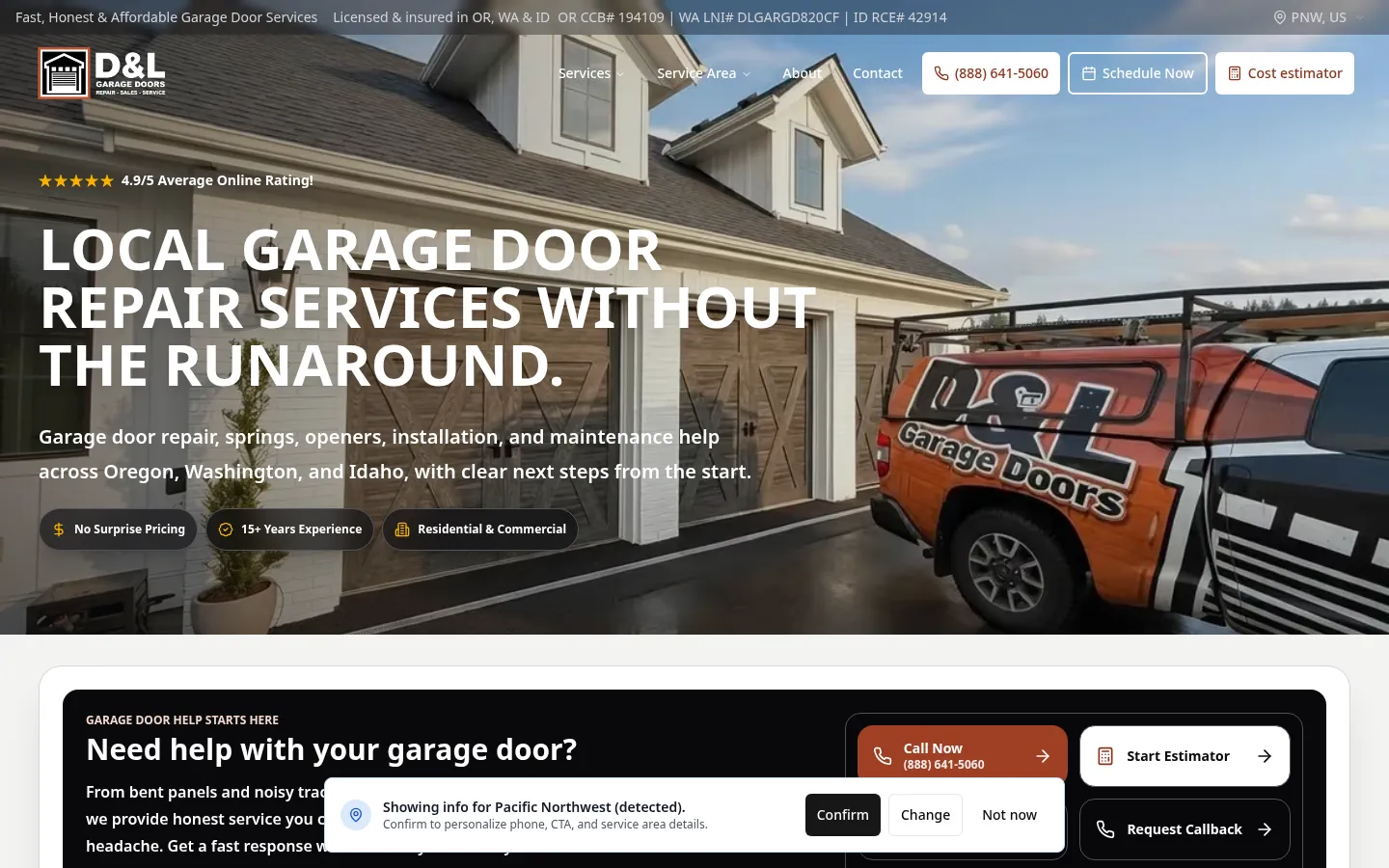
D&L Garage Doors
Turning a multi-region garage-door business into a clearer digital service and booking platform.
Hi, I'm Morten — an independent web designer building sharp, fast websites around a clear offer and a real next step.

A good-looking website should do more than collect compliments.
It should make the right people trust you, understand your value, and take the next step.
I design websites that convert visitors into paying customers. Every project is built around your offer, your audience, and the decisions people need to make before they contact you.
LOOK EXPENSIVE.
LOAD FAST.
CONVERT BETTER.
The work is structure, copy, speed, and next-step clarity working together.
Template-first pages
A custom structure around your offer
Heavy pages that feel slow
A lean build that gets out of the way
Confusing navigation
A clear path to the next step
Vague conversion copy
Copy tied to what visitors need to decide
Contractors, consultants, and agencies that need to turn local or qualified traffic into real inquiries.
Founders with a proven offer who need a sharper landing page, stronger positioning, and a cleaner conversion path.
Independent professionals who need their website to communicate authority and sell their expertise.
Businesses replacing an outdated site that no longer reflects the quality of what they deliver.
Websites that turn visitors into paying customers.
No endless back-and-forth. No confusing jargon. Just a clear path from idea to launch.
We talk about your goals, your audience, your offer, and what the website needs to accomplish.
I create a custom visual direction shaped around your business rather than forcing your offer into a template.
Your approved direction becomes a fast, responsive, pixel-precise website built for real devices.
Your site goes live with testing, handoff guidance, and the support needed to keep it working.
Real products, platforms, and brand systems — each one designed to look expensive, load fast, and move people toward a clear next step.
Turning a multi-region garage-door business into a clearer digital service and booking platform.

Bringing the messy week before matchday into one role-aware operating system.

A digital identity for a studio built by operators — not spectators.

A youth football club concept where elite ambition, inclusivity, humor, and culture belong to the same identity.

A welcoming camp experience that turns local interest into informed, confident registration.

A disciplined launch experience for a football company building tools for the work behind the game.

I work directly with every client from the first conversation through launch. No account managers. No generic handoffs. No disappearing behind a production team.
I build for founders, professionals, and service businesses that need a website capable of doing real commercial work—each one designed around its own purpose rather than forced into a borrowed structure.
Get the scored checklist I use to review a page for offer clarity, trust, mobile friction, speed, and follow-through.
Read the 18-rule field guideTell me what needs to change and I'll reply personally after reviewing the details. Prefer something quicker? DM me on X or send an email.
Morten reviews the goals, scope, timing, budget range, and fit. If the project looks aligned, you receive a personal response with the clearest next step and any useful follow-up questions. The inquiry does not book a project or create an obligation.
Most projects are planned around a two-to-four-week delivery window, depending on scope, content readiness, feedback timing, and technical complexity. Smaller launch or cleanup scopes can move faster when the materials and decisions are ready.
Every project is scoped before work begins. Many website projects fall between $2,000 and $6,000, but the actual quote depends on pages, content, integrations, platform, timeline, and handoff needs. You receive a fixed scope before paid work starts. The separate weekly design and build partnership is $2,000 / week for one agreed workstream; scope, timing, and terms are confirmed before work begins.
A typical engagement includes offer and audience clarification, custom visual direction, responsive design, front-end implementation, copy direction, basic SEO, launch QA, and practical handoff notes. Extra integrations, ecommerce, advanced content systems, or ongoing support are scoped separately.
Yes. Copy is treated as part of the product experience, not filler. If you already have copy, Morten can sharpen the structure and language. If you do not, the inquiry and discovery process help turn the offer, audience, proof, and next step into usable page copy.
The platform depends on the job. Framer and Webflow are useful for fast, maintainable marketing sites. Shopify, Notion-based systems, and custom Next.js-style builds are considered when the product, content, commerce, or performance needs make them a better fit.
Yes, when the chosen platform supports client editing. Handoff can include access, guidance, and notes for making normal content updates. More technical updates, new pages, integrations, or design changes can be handled as follow-up work.
The useful starting point is a clear problem, a current website or reference if one exists, rough timing, budget range, brand or content assets, and any constraints. You do not need a polished brief; the form is designed to help organize the first version.
Revision expectations should be defined in the project scope before work begins. The goal is not endless subjective tweaking; it is a clear feedback loop around whether the page communicates the offer, earns trust, and moves visitors toward the right action.
Basic launch QA is part of the working standard: responsive checks, metadata, links, forms, performance basics, and clear success states. Analytics can be added in a privacy-conscious way, focused on page views and key interactions rather than invasive tracking.
This is a good fit for founders, creators, service businesses, and small teams that want a site built around a specific offer and decision path. It is not a good fit for fake proof, rushed claims, unclear ownership, or work that needs to mislead visitors.
The Trust Center explains inquiry handling, checklist delivery, analytics boundaries, accessibility scope, third-party services, and project-agreement expectations. Privacy, Terms, and Accessibility pages provide the supporting policy details.